“Green Vitality” from Germany to Taiwan
Research project on the cross-cultural transplantation of St. Hildegard’s Naturopathy and her Healing Garden

This research project examines the cross-cultural translation and transplantation of St. Hildegard’s naturopathic medicine from Germany to Taiwan, focusing on the relationships between religion and health, humans and plants, and humans and the environment. The primary fields are the St. Hildegard Association in Taiwan and the Healing Garden of St. Hildegard (Figure 1). They committed to introducing St. Hildegard’s medieval naturopathy to Taiwanese society.
This study addresses three core questions: how the concept of naturopathy is translated from Germany to Taiwan; how St. Hildegard’s naturopathic ideas are localized and negotiated within Taiwanese society; and how local actors enact naturopathic concepts, herbs, and plants in everyday practices of self-care and healing.
This research explores how St. Hildegard’s naturopathy and religious practices, referred to as “Green Vitality,” have emerged as a new health paradigm in Taiwan. This approach highlights their aesthetic, sensory, and spiritual healing capacities. Applying multi-sited ethnography, semi-structured interviews, and participant observation (Figure 2 and Figure 3), this study investigates how Western natural therapy concepts interact with local medical and religious traditions, and how “Green Vitality” reshapes human-environment relations.
This research was funded by the Landesgraduiertenstipendien 2025-2028.
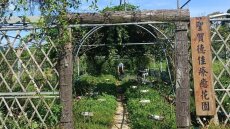
St. Hildegard’s Healing Garden in Longtan, Taiwan
Image: Jui-Hsin Cheng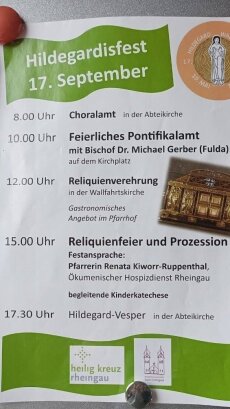
Programme of the Hildegardifest
Image: Jui-Hsin Cheng
The Relic Procession in Hildegardsfest 2024
Image: Jui-Hsin Cheng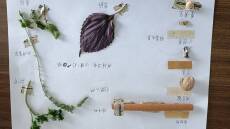
Hildegard’s herb guide made by participants during the promotional activity
Image: Jui-Hsin Cheng
St. Hildegard’s Abbey in Bingen, Germany
Image: Jui-Hsin Cheng