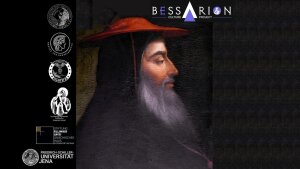
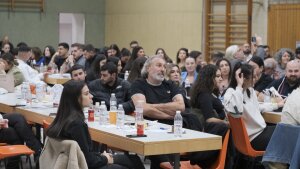
Conference "The Greek Heritage of Pontus: interdisciplinary perspectives"
The draft programme from our conference that took place on the 18th and 19th of May 2025
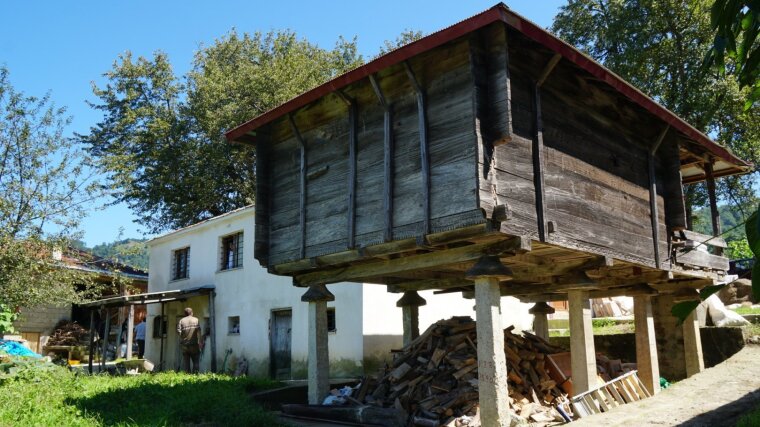
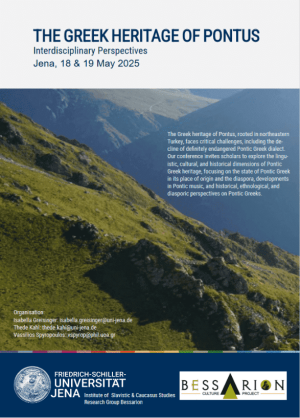
Plakat der Tagung "The Greek Heritage of Pontus"
Illustration: Thede KahlSince 1922-23, the Greek heritage of Pontus, a region located along the southern Black Sea coast in present-day northeastern Turkey, has been predominantly preserved within the Pontic diaspora in Greece and various parts of the world. At the same time, its roots in the Pontus region itself are becoming increasingly rare. The year 2025 marks 112 years of the development of Pontic Greek cultural heritage outside of Asia Minor. The challenges faced by the Greek heritage of Pontus extend beyond the events of 1916 (persecution of the Pontic Greeks) to 1923 (a population exchange and the Treaty of Lausanne Conference). Recent decades have presented significant challenges to the survival of Pontic Greek culture, especially as the Pontic Greek dialect approaches extinction; UNESCOExterner Link and EthnologueExterner Link classify Pontic Greek as a "definitely endangered" language.
This conference explored both the synchronic and diachronic aspects of the Pontic Greek heritage of Asia Minor. Our goal was to discuss, analyse and compare the characteristics and status of Pontic Greek culture both before and after 1923 from a multidisciplinary perspective. The following questions were addressed:
The conference was organized by Isabella Greisinger, Thede Kahl, and Vassilios Spyropoulos.
Click here to open the Book of Abstracts.pdf, 637 kb
The conference took place in: Auditorium "Zur Rosen", Johannisstraße 13, 07743 JenaExterner Link.
Welcome speeches and Introductions of the Organizers of the event Isabella Greisinger, Thede Kahl and Vassilios Spyropoulos
Statements from Parthena Iordanidou, Anastasia Kasapidou-Dick and Dimitris Lampropoulos.
(German - Greek)
Kaum eine Region verbindet so eindrücklich Landschaft, Geschichte und Erinnerung wie der Pontos – jenes Gebiet an der südlichen Schwarzmeerküste, das über Jahrhunderte Heimat griechischer Gemeinschaften war. In seinem Vortrag „Ο Πόντος ανά τους Αιώνες“ nimmt uns der Pädagoge Efstathios Taxidis mit auf eine faszinierende Reise durch Raum und Zeit: Anhand eindrucksvoller Postkarten vom Ende des 19. und Beginn des 20. Jahrhunderts eröffnet sich ein lebendiges Bild des pontischen Lebens, von Städten und Dörfern, vom religiösen und kulturellen Erbe – aber auch von Umbrüchen und Verlusten. Der Vortrag ist mehr als eine historische Darstellung: Er ist eine visuelle Spurensuche, eine Einladung, die Vergangenheit des Pontos mit neuen Augen zu entdecken.
Πρόσκληση σε ένα ιστορικό ταξίδι στον Πόντο. Λίγες περιοχές συνδυάζουν τοπία, ιστορία και μνήμη τόσο έντονα όσο ο Πόντος – η γη στις νότιες ακτές του Εύξεινου Πόντου που για αιώνες υπήρξε πατρίδα ελληνικών κοινοτήτων. Στην ομιλία του με τίτλο «Ο Πόντος ανά τους Αιώνες», ο εκπαιδευτικός Ευστάθιος Ταξίδης μάς ταξιδεύει στον χώρο και τον χρόνο μέσα από σπάνιες καρτποστάλ του τέλους του 19ου και των αρχών του 20ού αιώνα. Οι εικόνες αυτές δεν είναι απλώς τεκμήρια του παρελθόντος· είναι παράθυρα σε έναν κόσμο που χάθηκε αλλά άφησε ανεξίτηλα ίχνη: πόλεις και χωριά, εκκλησίες και σχολεία, καθημερινή ζωή και γιορτές, αλλά και οι σκιές των διωγμών και της εξόδου. Ο Πόντος αναδύεται μέσα από τις εικόνες – ζωντανός, πολύπλευρος και συγκινητικός.
Like every young state, the Empire of Trebizond needed after its’ foundation a circle of scholars to undertake the administration of the Empire and develop imperial propaganda. The establishment of a local scholarship in Pontos progressed rather slowly, depending on the inflow of intellectuals from Byzantium (Rosenqvist 2005, 38-48). The Byzantine scholars were looking for better career opportunities at the court of the Grand Komnenoi or intended to study astronomy from translated Persian handbooks which were a result of Gregory Chioniades’ activities. Chioniades was a physician and astronomer from Constantinople who spent much of his life in Persia and in Trebizond and played an important role in the local intellectual life by offering his work to the capital city of Pontos (Kafasis 2021, 252-253).
The political instability following the death of Emperor Basileios in 1340 and the decline of Trebizond as a center of astronomical studies led to the end of the immigration of scholars from Constantinople and the development of a local scholarly circle. Their literary work was under the direct influence of Byzantine models, although we can observe some elements in language and themes expressing regional characteristics (Stefec 2023, 296-300). The lack of opportunities for quality higher education in Pontos resulted in the emigration of talented young students who left their homeland and traveled to Constantinople to study. They either returned and obtained higher positions in the service of the Grand Komnenoi, or – as the case of Bessarion suggests – they remained abroad but maintained strong ties
with their hometown (Giarenes 2007).
This paper presents a brief overview of scholars and scholarly activities in the Empire of Trebizond, the local characteristics in their literary production and their relation to the Byzantine intellectual life as well as their contribution to the so–called Palaeologan Renaissance.
Bibliography:
Crypto-Christianity in the Pontus, particularly in the region around Trabzon (Trapezunt), was a
significant social phenomenon during the Ottoman period. Many Christian communities, officially converting to Islam, secretly preserved their Christian practices and identities. This paper examines crypto-Christianity in the Pontus, focusing on the survival strategies and cultural adaptations of the people in the region. Special attention is given to the community of Istavris, whose history exemplifies this phenomenon. The study analyzes how these hidden Christian traditions continued into the present and their role in shaping the religious and cultural identity of the region.
15:30 - 15:50: Discussion
15:50 - 16:20: Break
This paper examines the interplay between migration, displacement, and cultural resilience through the experiences of Pontic Greeks and Greeks from Asia Minor. Using the dual vectors of forced displacement during the genocide (1914–1923) and economic migration during the Gastarbeiter era (post-1950), it explores how identity is both preserved and transformed across generations and geographies. The first wave of migration enabled survival amidst trauma, while the second wave sought economic stability, highlighting how different contexts shaped resilience.
Despite geographical rupture and linguistic decline, Pontic identity endures through traditions like dance and music, as core commemorative practices. These cultural pillars connect generations and anchor identities, allowing individuals to selectively engage with their heritage. For instance, those who do not speak Pontic Greek may still participate in its dances, while descendants rooted in shared narratives maintain a connection to their ancestral past without direct ties to Pontus.
The paper posits that (1) displacement fosters resilience by reinforcing collective practices in new environments and (2) identity transformation is adaptive and anchored, adapting to shifting contexts while rooted in stable cultural traditions. Using an inductive approach informed by personal observations and secondary literature analysis, this study connects Pontic Greek identity with broader Greek identity drawing upon official and communal practices. It explores how these traditions reach into the present, including artistic connections to Greek rap music that references Pontic heritage. This research contributes to discussions on cultural survival, adaptation, and the paradoxes of migration.
On 18 November 2023, the Museum of Refugee Hellenism was inaugurated at AEK’s OPAP Arena in Nea Filadelfia, Athens. This moving and historically significant institution is dedicated to preserving and showcasing the legacy of the Asia Minor, Pontic, and Constantinopolitan Greek refugees who rebuilt their lives in Greece after the forced population exchanges of the early 20th century. The museum was blessed by Metropolitan Gavriil and inaugurated by Deputy Minister Ioannis Vroutsis, with a keynote speech by Dimitris Melissanidis, who envisioned the stadium not only as a sports venue but as a center of memory and culture. Named “The Ark of Romiosyny” by famous composer Mikis Theodorakis, the museum tells the story of uprooted communities, survival, and cultural resilience through priceless relics, personal items, and multimedia exhibitions. The event was attended by political, cultural, and religious figures who emphasized the museum’s national and educational value.
Με την ποντιακή μουσική ήρθα σε επαφή για πρώτη φορά στης αρχές του 1990. Έχοντας τελειώσει σπουδές κλασικής μουσικής στην Πολωνία και με παρουσία ήδη δέκα ετών στην Ελλάδα, αυτή η επαφή μου δημιούργησε ένα μεγάλο σοκ. Το πρώτο στοιχείο που μου έκανε εντύπωση ήταν η ρυθμική αγωγή της ποντιακής μουσικής. Μου ήτανε αδύνατο να προσδιορίσω το χρόνο της μουσικής. Αμέσως αντιλήφθηκα ότι ο χρόνος της είχε να κάνει με τη ρυθμική αγωγή της ίδιας της ποντιακής διαλέκτου.
Έχοντας ζήσει ανάμεσα σε πολλούς φίλους ποντιακής καταγωγής είχα την πολύτιμη εμπειρία να ακούσω την ποντιακή διάλεκτο και με τη μουσική της έννοια. Γρήγορα κατάλαβα ότι για μένα ήταν αργά να μάθω και να κατανοήσω την διάλεκτο αυτή. Η διαδικασία κατανόησης της θα μου έπαιρνε πολλά χρόνια.
Έχοντας αναπτύξει την έντονη μουσική, παιδαγωγική και συνθετική μου δράση, μέσα μου είχε ωριμάσει η ιδέα να ενσωματώσω σε αυτή διαδικασία τα πολύτιμα στοιχεία της ποντιακής μουσικής. Ένιωσα την εσωτερική ανάγκη να την παρουσιάσω με διαφορετικό τρόπο και μάλιστα να το κάνω στην πρώτη από τις δύο μου πατρίδες, στην Πολωνία. Το πρώτο μου έργο «Τρυγόνα» παρουσιάστηκε το 2018 στην πόλη Κατοβίτσε στο Μέγαρο Μουσικής NOSPR. Το έργο «Τρυγόνα» αποτελείται από τρία μέρη. «Πουλί»’ «Γυναίκα» και «Χορός». Ήταν ένα ευγενικό κάλεσμα του πολωνικού κοινού σε ένα ταξίδι στον κόσμο του άγνωστου σε αυτό το ακροατήριο, ποντιακού ελληνισμού. Σ` αυτό μου το έργο, όπως και αργότερα σε άλλα, ενσωματώνω την ρυθμολογία, τις κλίμακες και το ήθος της ποντιακής μουσικής, σε γνώριμα για τον πολωνικό κοινό αρμονικά και ενορχηστρωτικά στοιχεία. Αργότερα το έργο αυτό πήρε την δομή της σουίτας με τίτλο » Ποντιακή Σουίτα» το οποίο εκδόθηκε στην Ελλάδα το 2022 με την ανεκτίμητη βοήθεια του Συλλόγου Ποντίων Νυρεμβέργης.
Αργότερα το 2024, ακολούθησαν δύο έργα μου για ντουέτο κλασικής κιθάρας: «Τη Τρίχας το Γεφύριν» και «Πυρρίχιος». Στις δύο αυτές συνθέσεις προσπάθησα να αναδείξω τα μελωδικά και όπως πάντα ρυθμικά στοιχεία των θεμάτων από μια πιο ιμπρεσιονιστική οπτική γωνία. Η εκτέλεση των δύο έργων, τα οποία ηχογραφήθηκαν και βιντεοσκοπήθηκαν στην Πολωνία επίσης, έγινε από δύο εξαιρετικούς κιθαρίστες τον Marcin Kuźniar και τον Radosław Wieczorek. Και αυτήν την προσπάθεια, όπως και την έκδοση τους στην Πολωνία υποστήριξε χορηγικά ο Σύλλογος Ποντίων Νυρεμβέργης.
Το τελευταίο μου έργο είναι το “Ξημέρωμα στην Όκενα”. Σε αυτό περιγράφεται η προσπάθεια τον κατοίκων του χωριού Όκενα της περιοχής Όφεως Τραπεζούντας, να διατηρήσουν τη μητρική τους γλώσσα, την ποντιακή Η δομή του έργου είναι πολυφωνική, ενώ η μελωδία βασίζεται στην κλίμακα Σαμπάχ (σημαίνει επίσης-συμπτωματικά `ξημέρωμα`). Η πολυφωνία σαν δομή εκφράζει συμβολικά την αρμονική συνύπαρξη δύο και τριών φωνών χωρίς να επιβάλλεται κυριαρχικά η μία επί των άλλων.
Ελπίζοντας ότι η μουσική σαν παγκόσμια γλώσσα πρέπει να δέχεται και να αγκαλιάζει και αυτή την τόσο πολύτιμη, αλλ` όμως τόσο άγνωστη μουσική του Πόντου, προσπαθώ με την συνθετική μου δράση να συμβάλλω σε αυτό το όχι και τόσο ακατόρθωτο επιχείρημα.
17:20 - 17:40: Discussion
The Greek artist Sofia Amperidou is a self-taught painter with free studies in hagiography and engraving. Her artistic roots lie in Greek Byzantine art and through it she creates her works by studying the human geography of the Greeks with the concept of Romanism as a constant guide. Her paintings are anthropocentric and express concerns, thoughts and feelings about the past, the present and the future. They constitute "little books" that narrate the history and culture of the Greeks of the East, but also snapshots from the lives of the ancestors who gave her the inspiration and the spark of creation. The core of her work is the History, Folklore and Culture of Pontus. Through her works, she captures historical, heroic and nostalgic events and figures, who speak with warmth and emotion, bringing the past to life in the present.
18:10 - 19:00: Joint walk through the exhibitions:
Το πρόγραμμα περιλαμβάνει έκθεση έργων της εικαστικού καλλιτέχνιδος Μαρίνας Προβατίδου και του Στάθη Ταξίδη για την ιστορία του Πόντου. The program includes an exhibition of works by visual artist Marina Provatidou and Sofia Amperidou on the history of Pontus.
From 19:00: Common reception
Welcome speech of the dean of the faculty, Joachim von Puttkamer (Prof., PhD) and a greeting of Triandaphyllos Kotopoulos (ΠΔΜ).
The „Greek Diaspora“ or the presence of „Greeks abroad“ have a long-standing history. (Hassiotis, 1993; Clogg, 1999; Kitroeff 1999, Tziovas, 2009; Korma, 2017) The same is true for the conceptualization of such a diaspora in Greek and foreign historiography. (Laliotou, 2004, Ventura 2004, 2010; Bruneau, 2007; Tziovas 2009; Anagnostou 2010; Korma, 2017). The great number of Greek labour migrants arriving in Germany since the 1960s are also considered as representatives of such a diaspora. The migrants organized their everyday life in loose national/cultural communities, while later establishing as well regional associations, among them a number of Pontic associations in Germany. (Adamopoulou, 2024, Tseligka 2020, 2023). The presentation discusses the concept of a „Pontic diaspora“ and explores its various forms, parameters and mechanisms of diaspora constitution of Pontic Greeks in Germany using a historical approach.
Bibliography:
The linguistic-geographical atlas is a fundamental tool in the study of languages and dialects, as it maps their characteristics at different linguistic levels (Chambers & Trudgill 1998; Coseriu 1982). The absence of such an atlas for the Pontic dialect constitutes a significant gap in Modern Greek dialectology, despite its wide geographical spread, its long history, and its unique position in the evolution of the Greek language (Papadopoulos 1955; Tompaidis 1988).
The creation of an "Atlas of the Pontic Dialect" aims not only to document the dialect, but also to enhance its functionality in the contexts of education, community, and cultural preservation. The goal is to cover topics such as geography, historical development, and linguistic characteristics (phonetics, phonology, morphology, syntax, vocabulary), enriched with examples and dialectal texts (Hatzisavvidis 1985; Papadopoulos 1958–1961).
At the same time, data collection requires field research in conservative communities where traditional forms of the dialect are preserved (Dawkins 1936). The compilation of the atlas raises a number of epistemological and methodological questions, which must be considered in conjunction with practices established in other European countries (see Chambers & Trudgill 1998).
This paper attempts to revisit the request for an Atlas of the Pontic Dialect, setting out an initial framework of theoretical documentation and research strategy for its implementation.
Βιβλιογραφία / Sources
Vassilios Spyropoulos (National and Kapodistrian University of Athens) & Anthi Revithiadou (Aristotle University of Thessaloniki)
Pontic Greek originally consisted of a group of dialectal varieties spoken at the northeastern coast of Asia Minor. Although these varieties shared a common grammatical core, which defined them as a distinct linguistic group, there was substantial variation concerning a significant number of grammatical phenomena (Dawkins 1931, 1937, Papadopoulos 1933, 1955, Oeconomides 1958). In this paper we examine the variation attested in some of these grammatical phenomena, in order to illustrate that it is not accidental but, rather, it exhibits systematic patterns. We further claim that the incentive of this variation is found in both conservativisms and novel developments. The former involves old structures that were in the course of decay or disappearance, a process that was attested in variable stages in the relevant varieties. The latter pertains to new features that were set in motion in certain varieties or reached different stages of completion in others. Thus, variation opens a window to the development of the dialect in its course of history. In particular, our investigation will focus on the following phenomena: (a) vowel fusion of the diphthongs ea/ia and eo/io, (b) palatalization/affrication of certain dorsal consonants before front vowels, (c) omission of the article, (d) infinitival forms and constructions, (e) aspect neutralization in subjunctive and future syntagms, and (f) the spread of the plural inflectional pattern -i/-us. In addition, we will examine the fate of these phenomena and the relevant variation in the Pontic spoken nowadays in Greece. We will show that the relevant changes are associated with the formation of a Pontic Koine (Chadzisavidis 1995, Tombaidis 1992, 1996), and reveal three main strategies in its shaping: (a) pausing the course of certain novel developments by retreating to previous stages, which were possibly common to most Pontic varieties and resemble the corresponding Standard Modern Greek constructions, (b) spreading a development or a linguistic feature that was considered to be characteristic of the Pontic identity, (c) speeding up the disappearance of a certain conservativism and its subsequent developments in specific varieties.
References
Pontic is a member of the Hellenic branch of the Indo-European languages that developed out
of the Ionian dialects of Ancient Greek. The history of the endangered Asia Minor Greek dia-
lect group Pontic is characterized by a complex (interplay of) external and internal language
history. Within the Pontic dialect group, there is subdialectal microvariation (Sitaridou 2014),
but also koineization (Sitaridou 2014, Spyropoulos & Revithiadou to appear). The most con-
servative form of Pontic can be found in its place of origin at the southern coast of the Black
Sea in Pontus (Dawkins 1937, Bortone 2009), where it is still spoken today. Existing literature
focusses on Pontic subvarieties in situ (Turkey) and ex situ in countries like, e.g., Greece and
Russia (Dawkins 1937, Drettas 1997, Kahl 2008, Mackridge 1987, Oikonomidis 1958, Papado-
poulos 1953, 1955, Ralli 2020, Revithiadou & Spyropoulos 2012, Sitaridou 2014, Spyropoulos
2020, Spyropoulos & Revithiadou to appear, amongst others).
This work discusses Pontic in Germany, where a new ecosystem of Pontic emerges, from both
a diachronic and synchronic perspective. Based on own data gathered from fieldwork with the
Pontic Greek community in North Rhine-Westfalia, the external and internal language history
of Pontic in Germany and their interplay are investigated. Regarding the external language
history, data from biographical-narrative interviews are analysed with respect to the sociolin-
guistic situation of Pontic Greeks in Germany, focussing on the vitality of Pontic. As for the
internal language history, Pontic data from native speakers of Pontic in Germany are com-
pared to each other and to own Pontic data from native speakers in Greece regarding (mi-
cro)variation on the (morpho)syntactic and semantic level. Concerning the interplay of exter-
nal and internal language history, the consequences of the intense contact between Pontic
Greek and common Greek for the form of Pontic can be seen, for example, at the (morpho)syn-
tactic level.
Bibliography
10:25 - 10:45: Discussion
10:45 - 11:00: Break
The present paper aims to contribute to the academic discussion for a sustainable - in environmental, socioeconomic but also political terms - development of the Black Sea in its broader sense. In the first part we provide a literature review that highlights the importance of Pontian Greeks in the main periods of the history of the region, starting from the late Byzantine time till the time of Pontian Genocide, as well as the main characteristics in terms of sectoral structure and types of cross-regional economic relations. In the second part, we proceed with an ambitious economic and political assessment of actual contemporary contribution of Pontian community in the region, along with an evaluation of its networking, being institutionalized or not. Based on the above and considering the documented main challenges for the sustainable development of the Black Sea, we conclude on the importance of strengthening, linking and progressively collaborating historical ethnocultural identities in the region.
Indicative relevant literature:
This paper examines the perspectives of Pontic Greek speakers on language attrition, endangerment, and revitalization. Drawing on qualitative interviews across multiple generations, I investigate how historical language policies and sociocultural dynamics have shaped linguistic attitudes and practices. The study contrasts the experiences of elderly speakers, who recall language shaming and pressures to conform to Standard Greek, with those of the middle generation, who navigated the aftermath of educational reforms in the 1960s and 1970s, shaped by linguistic standardization. These policies intensified language stigma and contributed to the decline of Pontic Greek in social and familial settings. In contrast, the younger generation (aged 20–40) has encountered less discrimination and is now actively engaged in revitalization through writing, music, socio-cultural activities and digital initiatives. The challenges faced today by the Pontic Greek community in Greece and their efforts to revitalize and document the language clearly underscore the critical role of cultural acquisition in linguistic preservation while reflecting the broader global concerns about language endangerment and cultural loss.
By integrating community perspectives with recent scholarly insights, I explore perspectives on language attrition and revitalization while emphasizing the agency of speakers in preserving their linguistic heritage. Drawing also on studies of intergenerational transmission, such as Valdés (2016), who examines the role of community involvement in heritage language education, I address similar challenges within the Pontic Greek context. The transmission of language within families, particularly among the middle generation, remains crucial (Forrest, 2018; Purkarthofer, 2020) but is increasingly threatened by the loss of fluent elderly speakers. Finally, by applying Bradley & Bradley’s (2019) framework of language endangerment, I assess contemporary reclamation strategies and the urgent need for language along with cultural acquisition—whether passive or naturalistic—among children, as expressed by interviewees.
I conclude by arguing that the community’s shift from language shame to pride, mirroring grassroots movements across Europe’s minority language groups, has the potential to transform a historically marginalized language into an ever-growing symbol of linguistic resilience.
Bibliography:
12:00 - 12:20: Discussion
12:20 - 13:00: H.E. Alexandros Papaioannou (Ambassador of the Hellenic Republic in Germany): Joint walk to the monument of the Asia Minor Greeks. Wreath laying and minute of silence in memory of the victims of the Genocide of Pontic Greeks.
13:00 - 14:00: Lunch Break
In Pontus, Greek newspapers have been appeared since the 1880s and became immediately an important tool for keeping and strengthening Greek identity in the region. Shortly afterwards it was geographically extended and Greek newspapers were established by the Pontian activists in different places of the Russian empire with a significant number of Greek population. Among them, a Georgian littoral city of Batoum (Batumi) had a special place. Even its name has Greek roots as it comes from the Greek Vathy. This city enjoyed growing economic development since the 1880s until the First World War. This progress happened due to its important strategic location and very convenient port. At that period it was an unrivaled port-city in the whole Caucasus and eastern shores of the Black sea. As it was the nearest non-ottoman port to Trabzon, it attracted many Pontians who preferred to settle here. Shortly, they became very active in every field of Batoum’s life: political, social, economic, business and religious-cultural. They had their typography which published regularly newspapers and books in Greek. These Greek newspapers offer valuable information about Greeks in Batoum and the whole Russian empire, promoting their national ideals on Pontus. These newspapers were never investigated systematically. All of them are a valuable source for investigation of Pontian Greeks’ activities and struggle outside Pontus.
In the current paper we shall present all this material and how it can be evaluated for diaspora studies. We shall examine unknown aspects of the struggle for Pontus independence outside of this region and important but less known personalities. The question which can be arose based on this study is what was the role of Georgia’s Greek diaspora in the processes taken place in Pontus and how it is mirrored in Greek newspapers issued in Georgia.
References:
Η Ποντιακή Ελληνική, μια ιστορική διάλεκτος με ρίζες στην αρχαιότητα, έχει εξελιχθεί υπό την επίδραση ποικίλων γλωσσικών, κοινωνικών και πολιτισμικών παραγόντων. Η παρούσα εισήγηση αναλύει τους βασικούς παράγοντες που συνέβαλαν στη διαμόρφωση της Ποντιακής, εξετάζοντας τόσο τις εσωτερικές γλωσσολογικές διεργασίες όσο και τις εξωτερικές επαφές με άλλες γλώσσες και πολιτισμούς.
Επιπλέον, θα παρουσιαστεί η σημερινή χρήση της διαλέκτου, οι κύριες προκλήσεις που αντιμετωπίζει στην επιβίωση και τη διατήρησή της, καθώς και οι δυνατότητες αναζωογόνησής της σε σύγχρονα πλαίσια. Ιδιαίτερη έμφαση θα δοθεί σε προτάσεις για την ενίσχυση της εκπαίδευσης στην Ποντιακή, την αξιοποίηση των νέων τεχνολογιών και την προώθηση της γλώσσας σε πολιτιστικές και ακαδημαϊκές πρωτοβουλίες.
Μέσα από αυτή τη μελέτη, επιδιώκεται μια συνολική αποτίμηση της κατάστασης της Ποντιακής σήμερα και η διαμόρφωση προτάσεων που μπορούν να συμβάλουν στη μελλοντική της βιωσιμότητα.
Ο 19ος αιώνας, περίοδος σημαντικών παγκόσμιων αλλαγών, σηματοδότησε μια καθοριστική δημογραφική μεταβολή στα παράλια του Πόντου. Μέχρι τον 18ο αιώνα, δεν παρατηρούνται μαζικές μεταναστεύσεις προς την περιοχή, όμως από τον 19ο αιώνα, λόγω οικονομικών κυρίως παραμέτρων, παρατηρούνται συνεχείς μεταναστευτικές ροές. Οι μετακινήσεις των Ποντίων κατά τον 19ο αιώνα προς διάφορους προορισμούς εντός και εκτός του Πόντου είναι ευρέως γνωστές, καθώς και η εξάπλωση τους στη Μικρασία, τη Ρωσία και άλλες περιοχές. Σχετικά με τις εγκαταστάσεις πληθυσμών στον Πόντο, παρατηρούνται κατά τη διάρκεια του 19ου και 20ου αιώνα μεμονωμένα περιστατικά εμπορικών μεταναστεύσεων, κυρίως στα μεγάλα λιμάνια της Τραπεζούντας και της Σαμψούντας. Έμποροι από τη Μικρά Ασία, τα νησιά του βορειοανατολικού Αιγαίου και την ηπειρωτική Ελλάδα, αντιλαμβάνονται τις περιοχές αυτές ως ελκυστικά εμπορικά κέντρα και εγκαθίστανται εκεί. Ωστόσο, η πιο σημαντική εγκατάσταση χριστιανικού πληθυσμού, μη ποντιακής καταγωγής, ήταν αυτή των Καππαδοκών. Προερχόμενοι κυρίως από τις αγροτικές περιοχές της Καισάρειας και της Νίγδης, εγκαταστάθηκαν σε πόλεις του δυτικού Πόντου, δημιούργησαν ισχυρές κοινότητες, ενίσχυσαν το χριστιανικό πληθυσμό αλλάζοντας τις περισσότερες φορές το δημογραφικό χάρτη των περιοχών όπου εγκαταστάθηκαν. Η Σαμψούντα, χαρακτηριστικό παράδειγμα, εξελίχθηκε σε μια ισχυρή οικονομικά πόλη κατά τον 19ο αιώνα και αποτέλεσε έναν σημαντικό τόπο πολιτιστικής αλληλεπίδρασης μεταξύ Καππαδοκών και Ποντίων, διαμορφώνοντας μια ξεχωριστή κοινωνική και πολιτιστική ταυτότητα που άφησε ανεξίτηλο αποτύπωμα στην τοπική ιστορία. Σκοπός της μελέτης αυτής είναι να αναδείξει τα παραπάνω μέσω βιβλιογραφικής επισκόπησης και μελέτης αρχειακού υλικού.
Ενδεικτική βιβλιογραφία:
14:40 - 15:00: Discussion
From the time of the Greek colonisation, Pontic Greeks have been continuously present in the region of today's Abkhazia, which was a part of ancient Colchis. In the modern era, 19th century Ottoman-Russian wars, later on the Young Turk genocide on Asia Minor Christians led to an influx of Pontic Greek refugees into it [12]. After the 1923 treaty of Lausanne, Greeks continued to stay in the Black Sea region of the Soviet Union, but became victims of repression in the 1930s [4(193)]. In 1949, apparently connected to the defeat of the anti-imperialist forces in the Greek Civil War, the Stalin regime deported approximately 27,000 Abkhazian Greeks to Central Asia, from where a quarter managed to return up to ten years later [3, 5, 7, 10, 11, 12, 15-17, 19, 21, 24 (155-156), 25].
Greeks then again played an active role in the multi-ethnic Abkhaz society. A few examples of this are to be given [5,6,12,23]. In Abkhazia, after the dissolution of the Soviet Union which took place at the end of 1991, ethnic tensions between Abkhazians and Kartvelians escalated. Two weeks after Georgia in its Soviet borders had become a member of the UN with a non-elected military coup leadership, the latter started the 1992-1993 war against Abkhazia, claiming that Abkhazia is a part of Georgia [8(123-124),9,12,14(125),15-17,23,24(144,157-158)]. The invaders attacked Abkhaz and other non-Kartvelian people [18(87-88),22(13-18)], amongst them 453 Greeks were killed [13(17)], and erased cultural heritage, including that of Pontic Greeks [1,2(141),4(256),9,22(17),23,24(156,161)]. Those events caused the vast majority of Greeks to leave Abkhazia. Most of the Greeks left their homes for Southern Russia, or Greece [5,12,17,20]. While there were counted more than 14,000 Greeks in Abkhazia in 1989, only some 1,400 were remaining there in 2016 [5,12]. The unsecure situation, later on especially the difficult economic situation in Abkhazia has prevented Pontic Greeks from returning to Abkhazia [17(259-260)].
Sources
Since Antiquity, Greek has been spoken in Asia Minor and at the southern Black Sea coast. Muslim Pontic Greek (MPG, also: Romeyka) is an Asia Minor Greek variety still spoken in situ by several thousand Muslim speakers in Trabzon Province in Turkey (Sitaridou 2013). Due to the remote mountainous setting, MPG displays considerable micro-variation and has preserved unique archaic traits from older stages of Greek which are absent from other modern Greek varieties. After continuous language contacts with Turkish for several hundred years, MPG is currently facing language endangerment and shift towards Turkish (Sitaridou 2014: 28-29). Despite of a solid body of research on Christian Pontic Greek in Greece today (Drettas 1997; Revithiadou & Spyropoulos 2009, i.a.) and in Pontus prior to 1923 (Deffner 1878; Parcharidis 1880, 1888; Dawkins 1931, 1937), less research is available for MPG (but see Mackridge 1987; Sitaridou 2013; Neocleous 2020; Schreiber 2018, 2024, in press).
This paper investigates the linguistic situation of MPG in present-day Turkiye with a focus on (a) ethnographic language vitality, and (b) structural effects of bilingualism and language contact with the majority language Turkish. The current sociolinguistic situation is affected by language policies, identity issues, and both in- and out-group ambivalent attitudes towards MPG which accelerate language decline (Schreiber & Sitaridou 2017, Schreiber in press). Structurally, the grammar of MPG clearly shows influence of Turkish. Yet, language shift is not so much taking place at the structural level but rather in the pragmatic choices of bilingual speakers that reflect inhomogeneous speech groups and strong individual differences in language competence and use.
Research is based on ethnographic fieldwork in the Trabzon area since 2013, and more recent linguistic fieldwork within the scope of a PhD project on the grammar of Romeyka (Schreiber 2024).
References:
Η παρούσα ομιλία εξετάζει την έρευνα του Βαχίτ Τουρσούν με επίκεντρο τη γλωσσική και πολιτισμική παράδοση των Ρωμαϊκών της Όφης. Γεννημένος στο Köknar Köyü/Çaykara/Trabzon έχει αποκτήσει εκπαίδευση σε θρησκευτικά και αραβικά πλαίσια στο Çaykara Kuran Kursu, ενώ εξωτερικά παρακολούθησε το Trabzon İmam Hatip Orta Okulu. Μετά από επαγγελματικές εμπειρίες στη Λιβύη και στον τουριστικό τομέα στην Τουρκία, μεταναστεύει στην Αθήνα το 1989, όπου εστιάζει την έρευνά του στην ιστορία και τη γλωσσική εξέλιξη του Πόντου. Η ομιλία παρουσιάζει την πολυεπίπεδη μελέτη, που περιλαμβάνει συγκεντρώσεις και δημοσιεύσεις για την διατήρηση και ανάδειξη της παράδοσης της Ρωμαϊκής γλώσσας, καθώς και την ανάλυση του ιστορικού και τοπωνυμικού πλαισίου της περιοχής του Çaykara.
Contemporarily Pontians use the terms parakathi and muhabeti interchangeably to refer to the same cultural practice: an occasion of intimate socialization where social drinking and dining culminate ideally to the dialogical singing of poetry. However, connoisseurs of Pontic culture argue that the use of the two terms as identical is fundamentally erroneous and condemnable, a sign of cultural decline, of tradition adulteration, and of social decay. Accordingly, muhabeti should describe occasions of musicking dynamic, while parakathi social gatherings in general.
In this paper, coming from anthropology (Kavouras 2005) and ethnomusicology (Buchanan 1995; Turino 2014), and premised on participant observation and fieldwork on muhabetia, I offer an examination of what the debate about the “true” meanings of the terms entail. Specifically, drawing from metaphor theory (Lakoff 2003; Ricoeur 1977), semiotics (Short 2007), and Bakhtin’s genrification theory (1988), I offer a genealogy of the two terms: I trace the ways that the meanings of the concepts have changed reflecting and reproducing broader transformations of Pontic culture. I ultimate demonstrate that the two terms define a tension between complimentary but conflictual (Creed 1998) visions of Pontic sociality, the one being an idealization of past rural life and the other a celebration of music ecstasy as escape from social conventions. I further argue that these visions converse with broader Greek and post-Ottoman discourses on music, emotion, and sociality.
References:
16:20 - 16:30: Discussion
16:30 - 16:50: Break
The starting point of the lecture is the so-called Pontic flag, which is adorned with the verse Η Ρωμανία κι αν πέρασεν ανθεί και φέρει κι άλλο (Even if Romania belongs to the past, it will flower again and bear new fruit). This verse, which has become ingrained in the cultural memory of modern Greece, originates from an old Pontic folk song and lament about the conquest of Constantinople in the year 1453. The focus of the lecture is on the reception of the song. The scholar Konstantinos Xanthopoulos, born in Trebizond, published what is presumably the first written version of the text in 1849 in the journal Φιλολογικός Συνέκδημος. Versions of this equally concise and moving song, characterized by "noble simplicity and quiet grandeur", are included in the folk song collections of Arnold Passow (1860) and Émile Legrand (1873) in anthologies that have been widely received in Western Europe (cf. Maufroy 2009). Furthermore, there are also German translations of the song by Alois Luber (1877) and Hermann Lübke (1895). In the 20th century, Konstantinos Kavafis engaged in an intertextual dialogue with this song in his poem Πάρθεν (Parthen) (cf. Laoumtzi 2021). In the 21st century, it has similarly been re-semanticized and is now an integral part of commemorative events for the expulsion of the Pontic Greeks.
Bibliography:
A theatrical performance, imitating life, has the ability to depict cultural, linguistic and historical elements of the era it describes, through the sets, costumes, behaviors of heroes and of course through the scripts. In the case of Pontic Greek, theatrical texts are imprints on paper, of a cultural heritage, that was born in the historical Pontus, then developed into different places.
The research work is based on the theatrical texts found: 1. in Polykarpos Haitas archive of Pontic theatrical plays, in the library of the Committee for Pontian Studies, 2. in the books of Ermis Mouratidis about Pontic Greek theatre. All the plays are checked for their theatricality because, beyond language and tradition, the performance must lead the viewer to the emotions and ideas that the play itself expresses (Lampsidis, 1978). Also, all the texts meet two criteria that could define the scope of Pontic Greek repertoire: a) dialect and b) Pontic thematic (Kyriakidis 1998-1999). A look in present day productions is also carried out.
Authors belong to different generations and come from different regions of Pontus, so elements of local idioms and customs can be found. Plays are important from a folklore point of view, showing habits and behaviors of the Pontic Greeks in their historical homes (Iasonidou-Argyropoulou,1984). Equally important is the need of modern Pontic theatre to be placed in the contemporary environment of the places where Pontic Greeks are settled, depicting the processes and changes in the language and heritage and relating to life in reality after 1922 (Triantafyllidis, 2012).
Finally, wishing for the continuation of Pontic Greek theatre, this research work examines the linguistic situation today and tries to answer to the question whether Pontic theater performances can be a serious show that respects both its identity and its audience (Kyriakidis 1998-1999) and has the qualities to address a wider audience.
Bibliography:
Field research in eastern Pontus, for example through the collections of Pascaru, Kahl and Rousiakis, documents not only linguistic features of Pontic dialects, but also narrative memories, family structures and cultural practices in the context of flight, migration and linguistic marginalisation.
The lecture presents selected archival materials on Greeks in Asia Minor that were created at Friedrich Schiller University in Jena and at partner institutions such as the Austrian Academy of Sciences. The focus is on the VLACH and LaZAR repositories, which contain video recordings, transcriptions and field notes – many with speakers from formerly Greek-speaking regions of Turkey and their diaspora. Particular attention will be paid to the approach formulated by Kahl (2017) for documenting disappearing languages and cultures, taking into account an interdisciplinary recording of not only linguistic but also social and cultural contexts as part of a comprehensive understanding of endangered cultures. The methodological challenges will also be addressed: How can this data, which has often been collected in analogue form, be accessed, digitised and secured for the long term? What responsibility do research institutions have towards communities whose cultural heritage is threatened with extinction?
The examples presented show that archives contain not only language data, but also a hitherto largely untapped potential for research into cultural transformations, collective memory and transgenerational identity. Such data is becoming increasingly important in university teaching, in cooperation with speaker communities and in museums (e.g. exhibitions/screenings of biographical interviews). It enables a multi-perspective reappraisal of neglected content and creates space for participatory forms of memory culture.
Bibliography:
17:50 - 18:10: Discussion
18:15: Joint walk to the restaurant Adria Grill, Wenigenjenaer Ufer 15, 07749 Jena.