Semester Abroad
Study or do an internship abroad and gain valuable experience!
Collage with impressions from Graz, Szeged and Turku
Image: © Sonja Birkelbach/zgphotography/Igor Groshev - stock.adobe.com
Your semester abroad: simply explained
Doing a semester abroad offers you the opportunity to broaden your horizons, improve your language skills and get to know a different culture. Here you can find out what you need to know to plan your stay.
Can I do a semester abroad?

Turku
Image: © Igor Groshev – stock.adobe.com- You are enrolled at the Friedrich Schiller University Jena (Bachelor's, Master's or doctorate).
- You have completed at least the first year of study|academic year.
- You speak the language of the host country at a level that is sufficient for your courses (usually B1 or B2).
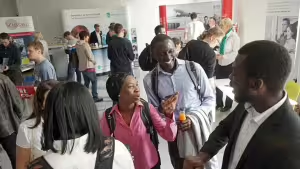
Teilnehmer einer Konferenz
Image: Jan-Peter Kasper (University of Jena)Internship abroad
You also have the opportunity to complete an international internship, where you can put your theoretical knowledge into practice and get to know a different culture and language at the same time. You will acquire important key skills for your everyday working life and expand your international network. This additional qualification makes it easier for you to successfully enter the regional and international labour market.
Where can I do my semester abroad?

Graz
Image: © Sonja Birkelbach – stock.adobe.comThe University of Jena offers the following opportunities:
- Stay abroad at the seminar's European partner universities as part of the ERASMUS+ programme: the Karl-Franzens University of Graz (Austria), the Åbo Akademi in Turku (Finland) or the University of Szeged (Hungary).
- Stays abroad worldwide via FSU Jena's bilateral exchange programmes (EC2U)
- Stays abroad as part of an internship
How long will my stay last?

szeged
Image: © tamas – stock.adobe.com- One semester or two, minimum 3 and maximum 12 months.
- Multiple funding: You are entitled to 12 months of Erasmus funding for each stage of your studies (BA, MA, PhD). This means you can use up to 36 months in total.
- Students without a Bachelor's/Master's structure (e.g. state examination) can be mobile for 24 months up to their first degree, then for another 12 months.
I am interested - how do I apply?
Contact the ERASMUS+ subject coordinator de, who will advise you on your options and support you with your application. You will need the following documents for your application:
- Application form
- Curriculum vitae in tabular form
- Motivation letter: Why abroad and why this institution of higher education?
- Language certificate (at least B1/B2)
- Proof|evidence of your previous academic achievements (Friedolin printout)
- Letter of recommendation from a lecturer (optional)
The application deadline for Erasmus is 15 January each year.
Contact us
For further information, please contact the Erasmus coordinator of the seminar:
Lea Horvat, Dr

- lea.horvat@uni-jena.de
- Phone
- +49 3641 9-44393
- Fax
- +49 3641 9-44392
- Link to download vCard
- vCard
- Further link
- To website de