- Beginn
- Ende
- Veranstaltungsarten
- Workshop
- Ort
-
Ernst-Abbe-Platz 8, 202
07743 Jena
Google Maps – LageplanExterner Link - Videochat
- Datenschutzhinweisepdf, 126 kb
- Veranstaltungssprachen
- Deutsch
- Englisch
- Barrierefreier Zugang
- ja
- Öffentlich
- nein
The Linguistic Description of Ukrainian
Hybrider Workshop am 13. Februar 2026
Workshop zur Ukrainischen Sprache in Zusammenarbeit mit Kolleg:innen aus Norwegen (The Arctic University of Norway)
Wir freuen uns, einen kleinen Workshop zur linguistischen Beschreibung des Ukrainischen anzukündigen und Kolleg:innen aus Norwegen begrüßen zu dürfen.
Der Workshop findet in englischer Sprache und in hybrider Form statt. Eine Online-Teilnahme ist möglich.
Programm
10:00–11:00
Laura Janda (UiT The Arctic University of Norway)
Alternative Construals of ‘Many’: Russian много and Ukrainian багато
11:00–11:10
Break
11:10–12:10
Tore Nesset (UiT The Arctic University of Norway)
Writing a Ukrainian Grammar: The Challenge of Prepositions
12:10–13:30
Lunch break
13:30–15:00
Session: Variation in Ukrainian
- Natalia Cheilytko (FSU Jena),
Lexical Variation in 20th-Century Ukrainian: Bottom-Up Case Studies - Mariia Shvedova (Kharkiv / FSU Jena),
The Vocative in Ukrainian Parliamentary Speech - Ruprecht von Waldenfels (FSU Jena),
Variationist Studies of Ukrainian Prepositions: An Overview
Abstracts:
Laura Janda – Alternative Construals of ‘Many’: Russian много and Ukrainian багато
We observe both singular and plural verb forms in combination with a quantified subject, as in Russian много людей пришло / пришли and Ukrainian багато людей прийшло / прийшли. However, the frequency and diachronic profiles for the two languages differ: whereas plural is attested with Russian много in only 5% of corpus examples and that distribution is stable over the past 200 years, in Ukrainian plural is found in 31% of examples and that number is growing over time. We apply a mixed-effects logistic regression analysis to a database of approximately 39,000 Russian examples and 28,000 Ukrainian examples to probe the effects of various factors on these distributions. We also consider the cognitive and linguistic motives for this so-called “syntactic singular” vs. “semantic plural” variation.
Tore Nesset – Writing a Ukrainian Grammar: The Challenge of Prepositions
In this presentation, I will present and discuss a grammar of Ukrainian, which I am currently writing together with my colleague Yuliia Palii at the Arctic University of Norway, and which is designed for second language learners of Ukrainian. I will first discuss the outline of the grammar and the structure of the text. I then address two general challenges: (a) differences between norm and usage and (b) understudied topics in Ukrainian linguistics. In the final part of my talk, I offer a case study of the challenges posed by Ukrainian prepositions. These challenges inter alia concern homonymy vs. polysemy, variation of form, case government, and the relationship between simple and complex prepositions.
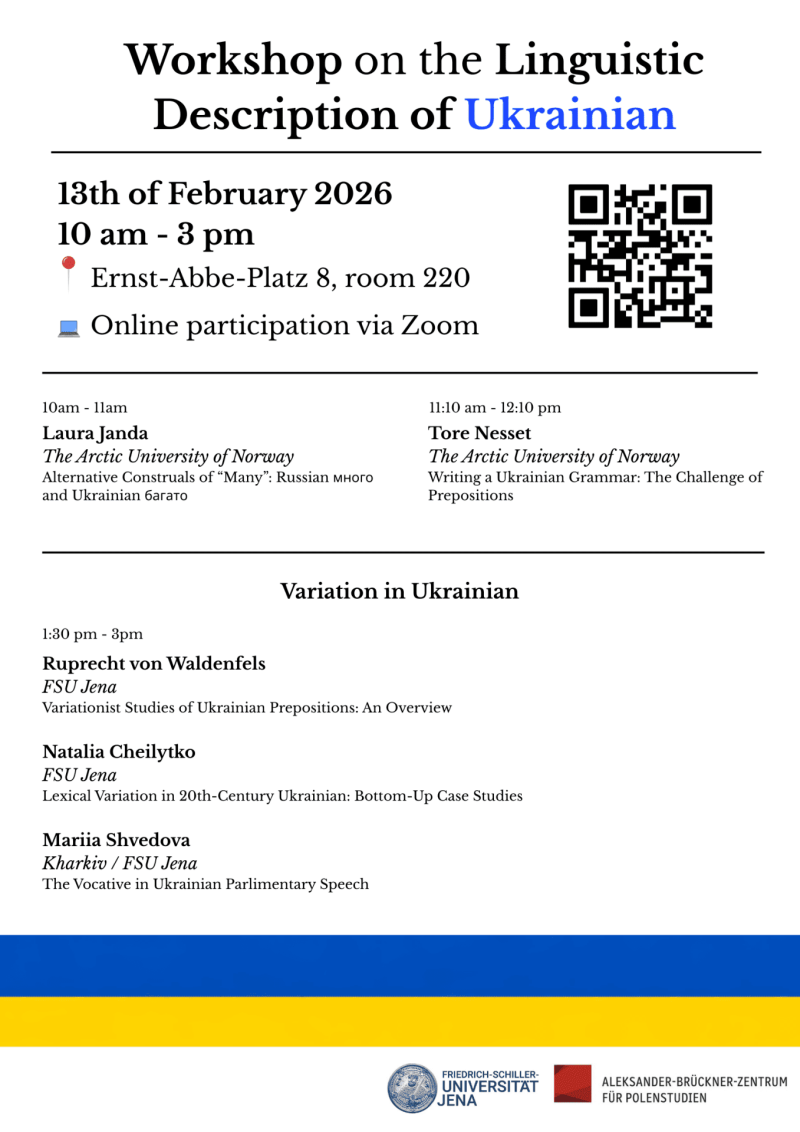
Plakat mit Programm für den Workshop zu Linguistic Description of Ukrainian
Illustration: Paula Böhm
Zur Übersicht
Veranstaltungseckdaten
Diese Veranstaltung im ICS-Format exportieren